A hiring manager sits through six back-to-back interviews on a Tuesday. By Thursday's debrief, the candidates blur together. "I think the third one mentioned supply chain experience?" Meanwhile, the recruiter's notes say "strong communicator, good culture fit" — for all six candidates.
This is not a hiring problem. It is a documentation problem. And it is costing companies their best hires.
The Real Cost of Bad Interview Notes
Most interview notes are written after the fact, from memory. Interviewers forget or distort up to 50% of what candidates actually said within 24 hours. The consequences compound quickly.
Without verbatim records, interviewers default to gut feelings and first impressions. Structured interview scores become meaningless when the evidence behind them is gone. Discrimination claims require documentation of what was actually discussed — "good vibes" is not a defensible hiring rationale.
Panel discussions become opinion contests instead of evidence-based evaluations. New hires mentioned specific goals and expectations during their interviews — but nobody wrote them down. HR teams are not careless. They are overwhelmed. The average corporate recruiter handles 30 to 40 open roles simultaneously.
The downstream effects are significant. A bad hire at the senior level can cost an organization 200% or more of the role's annual salary when you factor in recruiting costs, onboarding, lost productivity, and eventual replacement. Much of this cost traces back to the debrief room, where decisions are made on incomplete information.
Why Generic Transcription Tools Fall Short
Some teams have tried recording interviews with general-purpose transcription tools. Most quit within a month. Here is why:
- Speaker confusion. When your transcript labels everyone "Speaker 1" and "Speaker 2," you spend more time decoding who said what than you save on notes. In a panel interview with three interviewers and one candidate, accurate attribution is essential.
- Terminology gaps. HR has its own vocabulary — competency frameworks, STAR responses, cultural add versus cultural fit, situational judgment, behavioral indicators. Generic tools mangle these consistently, producing transcripts that require heavy editing.
- Privacy concerns. Candidates are already nervous. Telling them their audio is being sent to a cloud server that "may use data to improve services" kills trust before the interview starts. In regulated industries, the compliance implications are even more serious.
- No structured output. A raw wall of text is barely better than no notes. Hiring teams need summaries organized by competency, not a 45-minute transcript dump.
What Actually Works: From Conversation to Hiring Intelligence
The gap is not transcription accuracy alone — it is the full pipeline from conversation to structured hiring intelligence.
Accurate, Attributed Transcription
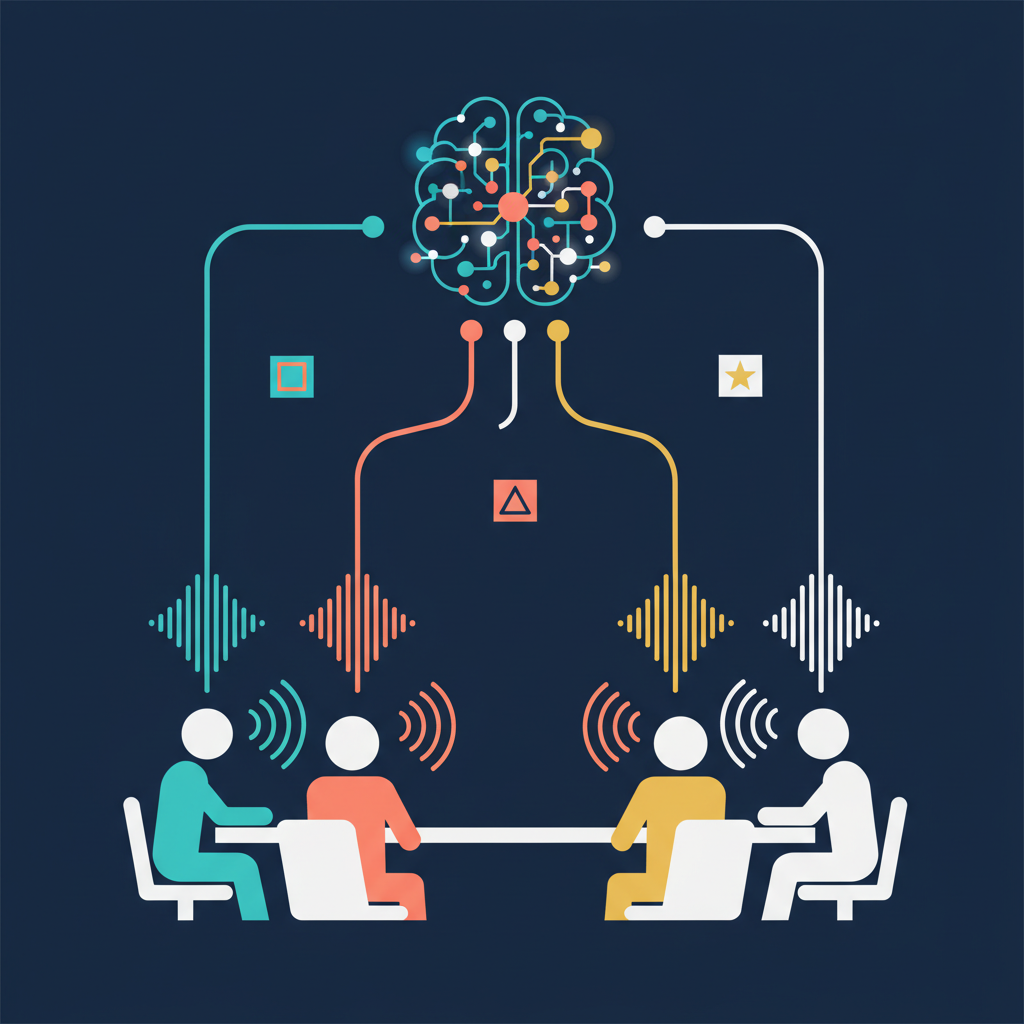
AmyNote's transcription runs through OpenAI's Speech API, which handles HR-specific terminology, accented English, and cross-talk between panel interviewers with consistently high accuracy. Speaker identification tags each person across the entire conversation, so you always know exactly who said what — the candidate's answer versus the interviewer's follow-up.
AI-Powered Competency Summaries
After the interview, Anthropic's Claude Opus generates structured summaries organized by the competencies you actually evaluate on. Instead of re-reading a full transcript, hiring managers get a breakdown: here is what the candidate said about leadership, here is their technical depth, here is where they described handling conflict.
This transforms the debrief from a memory exercise into an evidence review. Each interviewer can quickly reference exactly what the candidate said, not what they think they remember.
Cross-Interview Search
The search capability changes debrief culture entirely. Before the Thursday panel meeting, each interviewer can search across their candidates' transcripts for specific topics. "Show me everywhere Candidate 3 discussed cross-functional collaboration." Evidence replaces memory. Decisions get better.
For recruiters managing 30+ open roles, this means being able to quickly pull relevant candidate quotes during hiring manager conversations — even for interviews that happened weeks ago.
Privacy That Candidates Can Trust
Privacy matters more in HR than almost any other domain. Candidates share salary expectations, disability accommodations, personal circumstances, and career vulnerabilities during interviews. This information demands the highest level of protection.
Both OpenAI and Anthropic contractually guarantee zero training on user data. Audio is encrypted in transit; processing copies may be retained to deliver and recover requested features. Transcripts are stored locally on the interviewer's device with encrypted transport. Cloud processing copies are handled under the controls described in AmyNote’s Privacy Policy. No interview data feeding into model training pipelines.
The Compliance Dimension
Beyond better hiring decisions, AI-powered interview transcription creates a defensible audit trail. When every interview is documented with verbatim accuracy and speaker attribution, organizations can demonstrate consistent, fair evaluation processes.
This matters for EEOC compliance, internal audit reviews, and the increasingly common scenario where a rejected candidate requests documentation of their evaluation.
Getting Started
If your team runs more than a few interviews per week, the ROI is immediate. One structured debrief with actual evidence is usually enough to convince the rest of the team.
AmyNote offers a 3-day free trial with no credit card required. Transcription powered by OpenAI, AI analysis by Anthropic Claude Opus — both with zero-training guarantees.
Try it at amynote.app
Originally published as an X Article.